
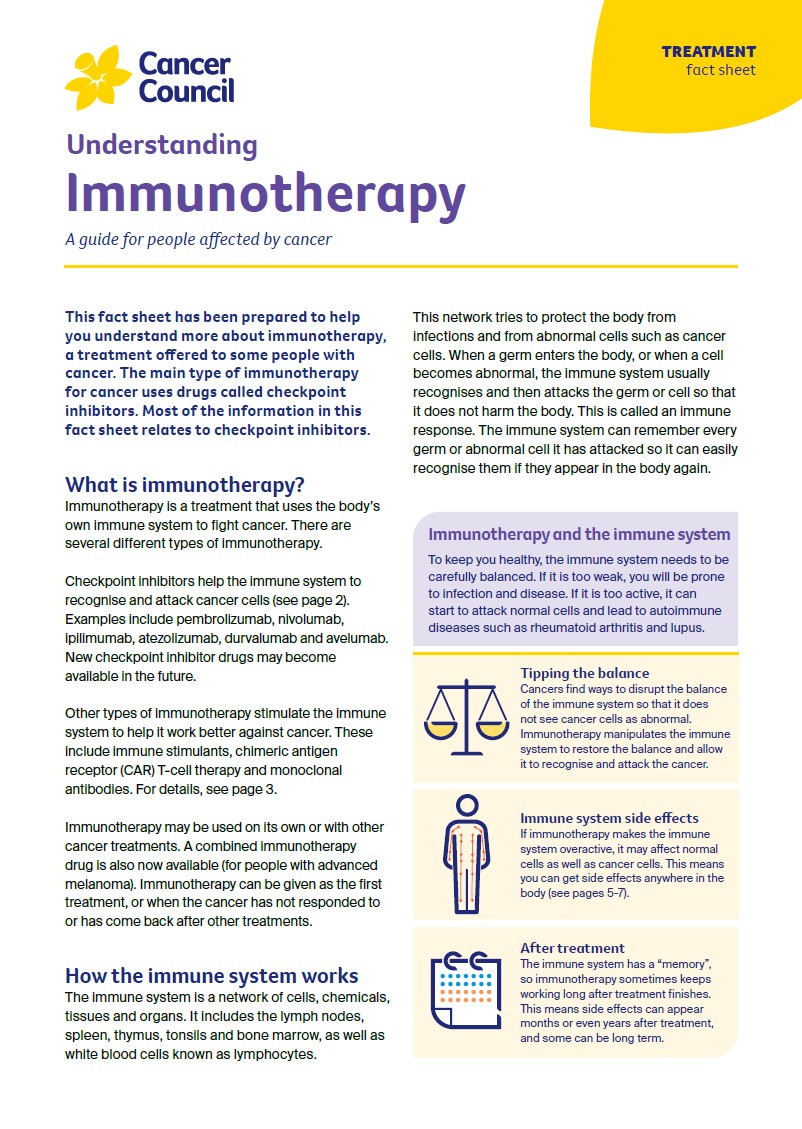
This is a type of drug treatment that uses the body’s own immune system to fight cancer cells. Different types of immunotherapy work in different ways. The most commonly used drugs are called checkpoint inhibitors. These drugs help the immune system to bypass “checkpoints” set up by the cancer that block the immune system. They often need to be taken for a long period of time.
Checkpoint inhibitors are currently available in Australia for some types of cancer. They have worked well for some people, but they don’t help everyone and it can be difficult to predict whether they will work in certain situations. New immunotherapy drugs are being developed – talk to your doctor about whether any are suitable for you.
Side effects
Immunotherapy can cause inflammation in different parts of the body, for example, in the:
- lungs (causing shortness of breath)
- bowel (causing diarrhoea)
- thyroid gland (leading to abnormal thyroid hormone levels).
Skin inflammation or rashes are more common.
Side effects of immunotherapy need to be reported to your doctor as they may be serious. Some side effects that might be okay after chemotherapy may not be okay after immunotherapy.
Learn more about the side effects of immunotherapy.
I was told that this new immunotherapy treatment was having great success with metastatic melanoma. The oncologist explained that there could be side effects. After the third infusion, I woke up with my heart going all over the place. The drug had drained my thyroid completely and I had to be cardio-averted to get the heart back to sinus rhythm.
Annabelle
→ READ MORE: Surgery for advanced cancer
Podcast: Treatment Options for Advanced Cancer
Listen to more of our podcast for people affected by advanced cancer
More resources

All updated content has been clinically reviewed by Dr Lucy Gately, Medical Oncologist, Alfred Health and Walter and Eliza Institute for Medical Research, VIC and Penny Neller, Project Manager, End of Life Law for Clinicians, Australian Centre for Health Law Research, Queensland University of Technology, QLD. This edition is based on the previous edition, which was reviewed by the following panel: Dr Lucy Gately (see above); Dr Katherine Allsopp, Supportive and Palliative Care Specialist, Westmead Hospital, NSW; Prof Megan Best, The University of Notre Dame Australia and The University of Sydney, NSW; Dr Keiron Bradley, Palliative Care Consultant, Medical Director Palliative Care Program, Bethesda Health Care, WA; Craig Brewer, Consumer; Emeritus Professor Phyllis Butow, Psychologist, The University of Sydney and Chris O’Brien Lifehouse, NSW; Louise Durham, Palliative Care Nurse Practitioner Outpatients, Princess Alexandra Hospital, Metro South Palliative Care, QLD; Dr Roya Merie, Radiation Oncologist, Icon Cancer Centre, Concord, NSW; Penny Neller (see above); Caitriona Nienaber, 13 11 20 Consultant, Cancer Council WA; Xanthe Sansome, Program Director, Advance Care Planning Australia, VIC; Sparke Helmore Lawyers; Peter Spolc, Consumer.
View the Cancer Council NSW editorial policy.