
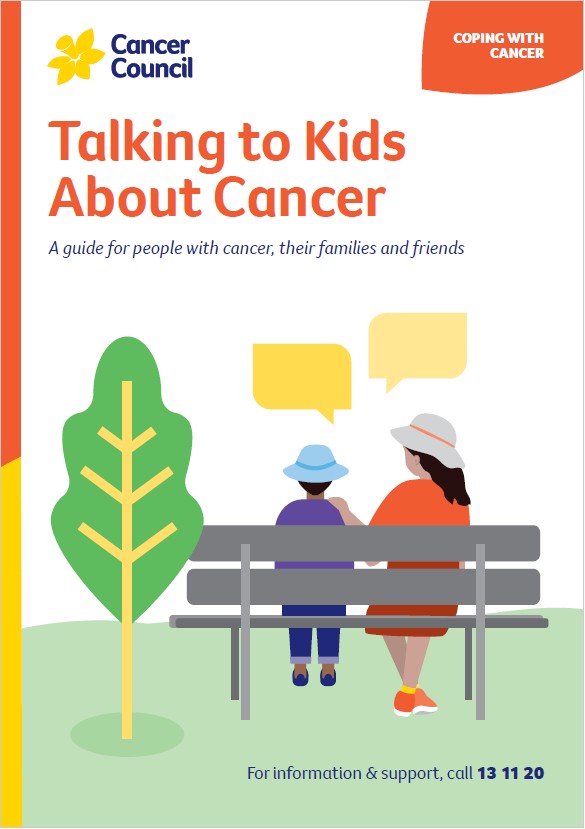
Providing children and young people with information about the treatment, why and how it is done, and possible side effects can help them to understand what to expect in the weeks and months ahead.
Learn more about:
Outline the treatment plan
- Let the children be your guide as to how much they already know and how much they want to know about treatment.
- Start with questions such as “Have you heard the word chemotherapy?” or “Do you know what radiation therapy is?”. Then explain the basic facts using language they can understand (see our Glossary).
- Check if your kids want to know more, and let them know that they can ask questions throughout the treatment period if they have other queries or concerns.
- Talk to kids about how to search for accurate information online (here is a list of recommended websites), to avoid incorrect or unhelpful information.
- Keep them up to date with how long treatment will take and the length of the hospital stay.
- Explain who will be taking care of the person with cancer and the different ways the carers will help.
Explain side effects
It’s important to prepare children for treatment side effects, such as weight changes, fatigue, nausea, scars and hair loss.
| Understand side effects | Explain that not everyone gets all side effects. People who have the same cancer and cancer treatment will not necessarily have the same side effects. Doctors can’t be exactly sure what will happen to each person. |
| Set expectations | Tell your children what side effects to expect, based on what the doctor has said, and how these may change how you look or feel. |
| Involve your children | Talk about ways your children can help you deal with the side effects (e.g. help shave your head or choose a wig). These actions make your children feel included and useful. |
| Reassure your children | Explain that side effects do not mean that you’re getting worse. It’s common for kids to get upset when they see the effects of the drugs, which may include fatigue or vomiting. They may worry that the treatment is making the cancer worse or that the cancer has progressed. |
| Coping with emotional reactions | Explain to them what side effects are considered normal. This can be especially important for older teenagers who might worry about when they should call for help. |
| Separate side effects from symptoms | If there are no side effects, reassure them that this doesn’t mean the treatment is not working. |
| Maintain family connections | If side effects mean you can’t join in usual family activities, make sure your children understand that it doesn’t mean you’re not interested. |
Making a day of it
“I knew that my hair falling out might be very traumatic for the kids. I invited 2 girlfriends around and involved the children in a self-indulgence day. I got one girlfriend to make scones while the other friend shaved my hair off. There was lots of laughter, the children got involved in the shaving, and then we all put on make-up and did our nails.”
ANNA, MOTHER OF TWO CHILDREN AGED 9 AND 13
→ READ MORE: Preparing for hospital visits
When my ex-wife got breast cancer, I talked to my little girl about how the treatment caused changes, like Mummy would get very tired and her hair would fall out, but we expected her to be okay.
SIMON, FATHER OF A 4-YEAR-OLD
Podcast: Explaining Cancer to Kids
Listen to more episodes from our podcast for people affected by cancer
More resources

Joanna Fardell, Senior Research Fellow and Deputy Director, The Behavioural Sciences Unit, School of Clinical Medicine, UNSW Medicine, UNSW, NSW; Dr Diana Adams, Medical Oncologist, Macarthur Cancer Therapy Centre and GenesisCare Campbelltown, NSW; Emma Bowne, 13 11 20 Consultant, Cancer Council SA; Ken Colbert, Consumer; Cara Dahl, Team Leader – Online Support, Cancer Hub, and ACA Registered Counsellor, NSW; Elizabeth Egan, Clinical Nurse Consultant – Oncology, St John of God Subiaco Hospital, WA; Dr Maria Ftanou, Director, Psychosocial Oncology Program, Peter MacCallum Cancer Centre, VIC; Nat Fuss, Senior Clinician, Canteen, SA; Helena Hobson, Senior Social Worker, Cancer Centre, Fiona Stanley Hospital and South Metropolitan Health Service, WA; Nadine Macbeth, Social Work Team Leader, Cancer and Chronic Care, Westmead Hospital, NSW; Damian Ragusa, General Manager – Services and Programs, Camp Quality; The Team at Redkite; Alexandra Wright, Consumer.
We would also like to thank the health professionals, consumers, organisations and editorial teams who have worked on previous editions of this title, and we are grateful to the parents and young people whose real-life stories have added to the richness and relevance of this booklet.
We also thank and acknowledge Dr Paula K Rauch, American Cancer Society, Macmillan Cancer Support, Jessica Watt and Diane McGeachy for permission to use their work as source material.
View the Cancer Council NSW editorial policy.