
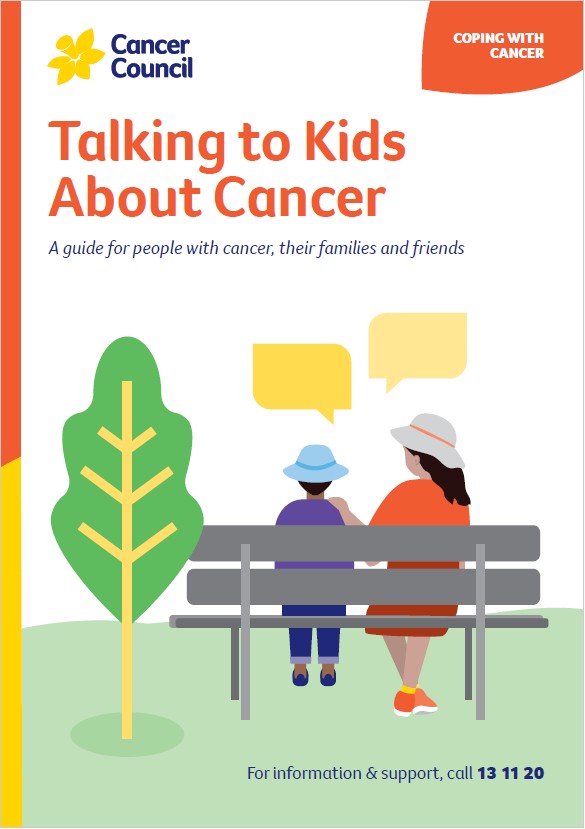
Learn ways to respond to difficult questions your children may have about your cancer diagnosis. Click the headings below to learn more.
For younger children: “Cancer is a disease that happens when bad cells stop the good cells from doing their job. These bad cells can grow into a lump and can spread to other parts of the body.”
For older children and teenagers: “Cancer is the name for more than 200 diseases when abnormal cells grow and rapidly divide. These cells usually develop into a lump called a tumour or they may spread through the blood. Cancer may spread to other parts of the body.”
This is the question that most parents fear, but often it doesn’t mean what you think. For example, younger children may really mean “Who is going to look after me?” Older children may be wondering, “Can we still go away during the school holidays?”
You can explain that the treatment you are receiving is the result of many years of research and that treatments are improving all the time. If your child knows someone who has died of cancer, let them know that there are many different types of cancer and everyone responds differently.
Children and teenagers often have many questions about death and dying. Cancer commonly prompts them to reflect on their own life and the lives of those they care about.
“We don’t expect that to happen, but I will probably be sick for a while. I am doing everything I can to be well. Sometimes it makes me sad, and I wonder if you get sad too.”
Visit this page for ways to approach end-of-life discussions
Some children may ask you directly if they caused the cancer, while others worry in silence, so it’s best to discuss the issue.
“It’s no-one’s fault I have cancer. Scientists don’t know exactly why some people get cancer, but they do know that it isn’t anything you did or said that made me sick.”
“You can’t catch cancer like you can catch a cold by being around someone who has it, so it’s okay to hug or kiss me even though I’m sick.”
“Cancer can spread through the body of a person with cancer, but it can’t spread to another person.”
“We will try to keep things as normal as possible, but sometimes I may have to ask Dad/Mum/Grandpa to help out.”
If you’re planning to inform teachers, the school counsellor or principal, talk to your kids first. Teenagers and even younger children may not want the school to know, so explain the benefits of telling the school and then chat about the best way to approach the discussion. Ask if your teenagers want to be involved in these conversations.
“You can tell your friends if you want to, but you don’t have to. People we know may talk about the diagnosis, so your friends might hear even if you don’t tell them. Many people find it helps to talk about the things that are on their mind.”
“Sometimes people talk about illness but they don’t know the full story. If the kids at school are talking about the cancer, let me know so we can discuss any things that they have got wrong.”
Letting kids know that they can help may make them feel useful, but it’s important that they don’t feel overwhelmed with responsibility. Some parents may feel hurt if their children don’t ask how they can help, but it’s common for children not to think to offer.
“Yes, there are lots of things you can do to help. We will work out what those things can be, and what will make things easier for everyone. Is there something in particular you would like to do?”
“Some help around the house would be good, but it’s important that you keep up with your schoolwork and you have some time for fun and for seeing your friends.”
→ READ MORE: What words should I use?
It is often helpful to talk to other parents who have or have had kids at a similar age to yours when diagnosed. Talking to another parent who has travelled the same road can be reassuring.
MIRA, MOTHER OF TWO CHILDREN AGED 3 AND 12
Podcast: Explaining Cancer to Kids
Listen to more episodes from our podcast for people affected by cancer
More resources

Joanna Fardell, Senior Research Fellow and Deputy Director, The Behavioural Sciences Unit, School of Clinical Medicine, UNSW Medicine, UNSW, NSW; Dr Diana Adams, Medical Oncologist, Macarthur Cancer Therapy Centre and GenesisCare Campbelltown, NSW; Emma Bowne, 13 11 20 Consultant, Cancer Council SA; Ken Colbert, Consumer; Cara Dahl, Team Leader – Online Support, Cancer Hub, and ACA Registered Counsellor, NSW; Elizabeth Egan, Clinical Nurse Consultant – Oncology, St John of God Subiaco Hospital, WA; Dr Maria Ftanou, Director, Psychosocial Oncology Program, Peter MacCallum Cancer Centre, VIC; Nat Fuss, Senior Clinician, Canteen, SA; Helena Hobson, Senior Social Worker, Cancer Centre, Fiona Stanley Hospital and South Metropolitan Health Service, WA; Nadine Macbeth, Social Work Team Leader, Cancer and Chronic Care, Westmead Hospital, NSW; Damian Ragusa, General Manager – Services and Programs, Camp Quality; The Team at Redkite; Alexandra Wright, Consumer.
We would also like to thank the health professionals, consumers, organisations and editorial teams who have worked on previous editions of this title, and we are grateful to the parents and young people whose real-life stories have added to the richness and relevance of this booklet.
We also thank and acknowledge Dr Paula K Rauch, American Cancer Society, Macmillan Cancer Support, Jessica Watt and Diane McGeachy for permission to use their work as source material.
View the Cancer Council NSW editorial policy.