

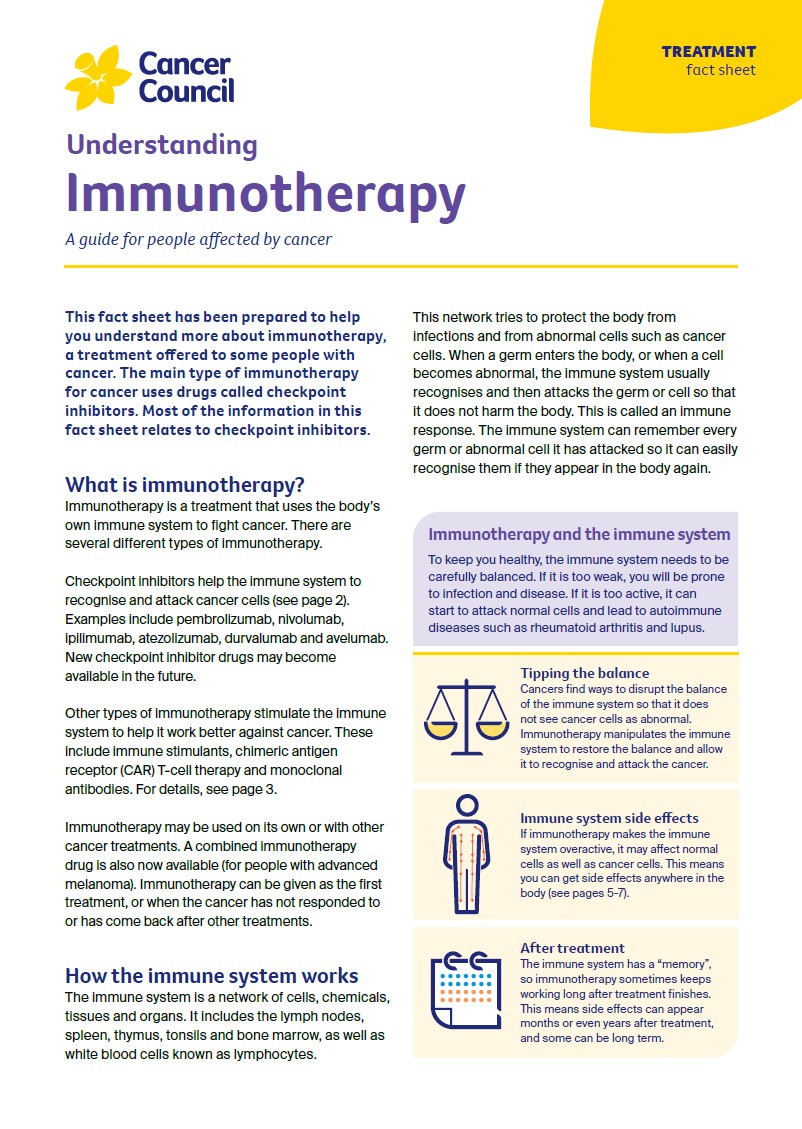
Cancers find ways to disrupt the balance of the immune system so that it does not see cancer cells as unusual.
Types of immunotherapy
Immunotherapy allows the immune system to recognise and attack the cancer. There are several different types of immunotherapy, and each works differently.
- Checkpoint inhibitors are the most common. Checkpoint inhibitors remove barriers that stop the immune system from finding and attacking cancer.
- Other types stimulate the immune system to help it attack cancer.
When it’s used
Immunotherapy using checkpoint inhibitors can be used for many types of cancer. Some checkpoint inhibitors are now available for any type of advanced cancer suitable for this treatment. Checkpoint inhibitors are also available in certain situations for some early-stage cancers, including lung and breast cancer. These drugs work well for some people, but not for everyone.
Immunotherapy can be given on its own or in combination with other treatments. For example, immunotherapy may be used after surgery to stop the cancer returning. It’s sometimes used in combination with chemotherapy or targeted therapy. This treatment can also be given when the cancer has not responded to other treatments or has come back after treatment.
How it’s given
Checkpoint inhibitors are given as a liquid through a drip inserted into a vein (intravenous infusion). They are usually given in repeating cycles, with rest periods in between.
Possible side effects of immunotherapy
Checkpoint inhibitors trigger an immune response that can cause side effects such as redness, swelling or pain anywhere in the body. Common side effects include skin rash and itching, diarrhoea, joint pain, fatigue and dry eyes. Rare but serious side effects include blurred vision, breathlessness and abdominal pain.
It’s important to tell your treatment team about any new or worsening side effects, as some can become serious and need to be treated differently to chemotherapy side effects.
Learn more about immunotherapy.
Antibody drug conjugate therapy
Antibody drug conjugate (ADC) therapy is a type of targeted therapy that’s used in Australia to treat certain cancers, including types of breast, bladder and blood cancers. ADC therapy is when an antibody is joined to chemotherapy medicine.
The drug combination attaches to the cancer cells, and destroys them. This therapy is targeted at the cancer cells, but can affect other cells. Ask your oncologist or haematologist if this treatment is suitable for you.
Video: What is immunotherapy?
Watch this short video to learn more about targeted therapy.
Podcast: Immunotherapy & Targeted Therapy
Download Easy Read and resources in other languages

Prof Desmond Yip, Senior Staff Specialist, Department of Medical Oncology, The Canberra Hospital, ANU School of Medicine and Psychology, ANU College of Health & Medicine, The Australian National University, ACT; Gillian Blanchard, Nurse Practitioner, Calvary Mater, Newcastle, NSW; Ken Colbert, Consumer; Laura Collins, Clinical Dietitian, GenesisCare, WA; Karen Gray, Consumer; Kate Lucking, 13 11 20 Consultant, Cancer Council SA; Louise Moodie, Director of Dietetics, Mackay Hospital and Health Service, QLD; Dr Shivanshan Pathmanathan, Medical Oncologist, Townsville Cancer Centre, Townsville University Hospital, QLD; Dr Marissa Ryan, Acting Consultant Pharmacist (Cancer), Princess Alexandra Hospital, Woolloongabba, QLD; Jayne Watson, Clinic Nurse Consultant, Peter MacCallum Cancer Centre, Melbourne, VIC; Stephanie Webster, Consumer.
View the Cancer Council NSW editorial policy.