
Learn about the important role of your healthcare team in cancer care. From GPs to specialists, they work together to provide you with support and treatment.
Learn more about:
Overview
When you notice symptoms that could be cancer, or have a screening test that shows something unusual, you’ll usually see a general practitioner (GP). Your GP will arrange some tests and scans. If the results suggest that you may have cancer, you’ll be referred to a specialist doctor for further tests. The specialist you see will depend on the type of cancer you have. After diagnosis, a team of health professionals will work with you throughout your treatment.
The people on your healthcare team
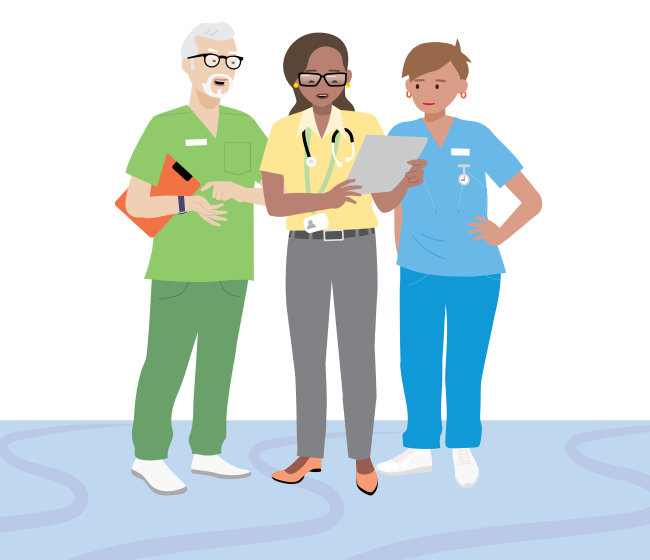
Some of the health professionals that you might see include:
GP or family doctor
Your GP supports you from cancer diagnosis and treatment to follow-up and survivorship. If you don’t have a regular GP, it’s a good idea to find one. A GP can:
- help you understand treatment options and prepare for treatment
- refer you to specialists and allied health professionals such as physiotherapists, dietitians or psychologists
- help arrange a second opinion if you want one
- continue to see you for day-to-day health issues and follow-up care
- get to know you and your medical history, and provide background to the cancer care team.
Cancer specialists
Cancer specialists diagnose cancer and guide your treatment and follow-up care. They may be a:
- medical oncologist – treats cancer with drug therapies (e.g. chemotherapy)
- surgeon – removes tumours and may perform some biopsies
- radiation oncologist – prescribes and oversees radiation therapy
- haematologist – diagnoses and treats diseases of the bone marrow, blood and lymphatic system.
Cancer specialists can:
- answer your questions about treatment
- work together as part of a multidisciplinary team to plan and deliver treatment
- be supported by junior medical staff (e.g. registrar), if you’re treated in hospital.
Specialist nurses
A specialist nurse coordinates your care from diagnosis through treatment. They work closely with specialists and other health professionals. They may be called a cancer care coordinator, clinical nurse consultant or clinical nurse specialist. Specialist nurses are often your main contact for questions and concerns. They can:
- provide information and support
- coordinate care for specific cancer types (in smaller hospitals, a general coordinator or the nursing unit manager may provide this support).
In rural areas, a cancer care coordinator may attend appointments with a visiting oncologist.
More than one nurse may be involved in your care (e.g. a surgical nurse, breast care nurse or stomal therapy nurse).
Psychologists and social workers
Various health professionals can help manage the emotional and practical impacts of cancer. You may see a:
- psychologist – helps you manage your feelings about diagnosis and treatment. They can provide counselling and advocacy at all stages of living with cancer. They may also support your family members and carers
- social worker – provides emotional and practical support, as well as advocacy, during times of crisis. They help access practical services (e.g. accommodation, transport, financial assistance, home care services). They can connect you with services that best meet your needs.
Learn more about Emotions and cancer.
Physical and occupational therapists
To help with mobility, day-to-day tasks and speech, you may see a:
- physiotherapist – helps you to move and exercise safely to regain strength, fitness and mobility
- exercise physiologist – designs exercise programs to help improve health, fitness, strength and energy levels, especially for people with medical conditions
- occupational therapist – provides equipment, aids and advice about getting back to your daily activities
- speech pathologist – helps with speech or swallowing issues after treatment.
Other health professionals
You may also see a:
- dietitian – helps with nutrition concerns and recommends changes to diet
- radiographer – performs x-rays, mammograms and other scans
- radiation therapist – plans and delivers radiation therapy
- genetic counsellor – gives advice if you have a strong family history of certain cancer types
- pharmacist – dispenses medicines and explains doses and side effects
- Aboriginal and Torres Strait Islander health professional – supports Aboriginal and Torres Strait Islander peoples with culturally safe care and advice
- multicultural navigator – supports people from various communities; may be available in some hospitals and cancer centres.
Choosing your specialist
It’s important to feel comfortable with your specialist. Some people are happy to leave the choice of specialist to their GP, while others want to be involved in this decision. Choosing specialists is not always possible (e.g. in the public health system), but if it is, you may consider:
- Specialties – Some doctors specialise in treating certain cancers.
- Multidisciplinary care – Health professionals who specialise in different parts of your care sometimes work together to plan treatment. This is called a multidisciplinary team (MDT). It may include surgeons, medical oncologists, radiation oncologists, cancer care coordinators, dietitians, psychologists and social workers.
- Specialist treatment centres – These centres treat many patients, including those with rare cancers.
- Your preferences – You may want to see all your doctors at the one hospital, even if it’s far away, or go to your local hospital for some visits to cut down on travel.
For more information on the health professionals you may see, see Understanding cancer or read about the type of cancer you have. People living with advanced cancer may also have other people in their health care team. Learn more about advanced cancer and palliative care.
For an overview of what to expect during all stages of your cancer care, visit Your guides to best cancer care. These short guides give an overview of diagnosis, treatment and beyond for a range of cancer types.
Video: Understanding cancer tests, treatment and support
Being told you have cancer can be overwhelming — but you’re not alone. This video explains what happens after a diagnosis, the different treatment options, and who might be on your treatment team.
Click on Settings  to turn on auto-generated subtitles in your language.
More resources

Prof Lisa Beatty, Professor in Clinical Psychology, Flinders Cancer Research, Flinders University, SA; A/Prof James Lynam, Medical Oncologist and Senior Clinical Advisor, Cancer Institute NSW; Dr Diana Adams, Medical Oncologist, Macarthur Cancer Therapy Centre and GenesisCare, Campbelltown, NSW; Bob Carnaby, Consumer; Dr Maria Ftanou, Director, Psychosocial Oncology Program, Peter MacCallum Cancer Centre, VIC; Mark Godfrey, Consumer; Prof Angela Hong, Radiation Oncologist, Chris O’Brien Lifehouse, Melanoma Institute Australia, GenesisCare, and Clinical Professor, The University of Sydney, NSW; A/Prof Brett Hughes, Senior Staff Specialist, Medical Oncologist, Royal Brisbane and Women’s Hospital, The Prince Charles Hospital and the University of Queensland, QLD; Kimberly Hurley, Consumer; Bronwyn Jennings, Gynaecology Oncology Clinical Nurse Consultant, Mater Health, QLD; Nadine Macbeth, Social Work Team Leader, Cancer and Chronic Care, Westmead Hospital, NSW; A/Prof Geri McDonald, Director Patient Experience and Wellbeing, Peter MacCallum Cancer Centre, VIC; A/Prof Orla McNally, Consultant Gynaecological Oncologist, Director Oncology/Dysplasia, Royal Women’s Hospital, Honorary Clinical Associate Professor, University of Melbourne, Director, Gynaecology Tumour Stream, Victorian Comprehensive Cancer Centre, VIC; Gail O’Brien AO, Consumer and Patient Liaison Advocate; Mariad O’Gorman, Clinical Psychologist, Liverpool Cancer Therapy Centre and Bankstown Cancer Centre, NSW; Deb Roffe, 13 11 20 Consultant, Cancer Council SA; Julie Teraci, Clinical Nurse Consultant – Melanoma, Cancer Network WA; Dr Elysia Thornton-Benko, Specialist GP/Primary Care and Cancer Survivorship Physician, Clinician Researcher, NSW.
View the Cancer Council NSW editorial policy.