
What is the Therapeutic Goods Administration (TGA)?
The Therapeutic Goods Administration (TGA) is the Australian government division that checks and monitors (regulates) all medicines and therapeutic goods sold in Australia. This includes complementary medicines such as herbs, vitamins, minerals, nutritional supplements, homeopathic remedies and some aromatherapy products.
The TGA’s role is to protect public health by making sure products:
- are manufactured safely and to acceptable standards of safety and quality, and do what they claim to do (efficacy)
- are produced in facilities that comply with Good Manufacturing Practice (GMP) both in Australia and overseas
- can be monitored for any adverse reactions and compliance (e.g. recalls, safety warnings, etc) while being sold.
The Australian Register of Therapeutic Goods (ARTG)
Most therapeutic goods available in Australia – whether made in Australia or overseas – must be listed on the Australian Register of Therapeutic Goods (ARTG). Some homeopathic preparations and specially made (compounded) medicines do not need to be listed on the ARTG. You can search the ARTG online to find a specific medicine.
Medicine codes and levels of risk
Medicines on the ARTG are given a code to show their level of risk. This code must be displayed on the medicine label.
| AUST L (listed) | These products make low-level health claims and contain pre-approved low-risk ingredients. The TGA checks them for safety and quality only, not for how well they work. Examples include sunscreen, some vitamin and mineral supplements, and some herbal medicines. You can buy them without a prescription at supermarkets, health food shops and pharmacies. |
| AUST L(A) (assessed listed) | These products make stronger health claims than other listed medicines and contain pre-approved ingredients. The TGA checks for safety, quality and whether the scientific evidence shows that the product does what it says it does. These products may have a “TGA assessed” symbol on the label. They are sold at pharmacies, supermarkets and health food stores, without a prescription. |
| AUST R (registered) | These products are considered higher risk. The TGA checks them for safety, quality and whether the scientific evidence shows that the medicine does what it claims. They include all prescription medicines, most over-the-counter medicines and some higher-risk complementary medicines. Registered complementary medicines may have a “TGA assessed” symbol on the label. |
Some complementary therapists are registered and accredited, but depending on the type of therapy they offer, some may not be.
→ READ MORE: Regulation of complementary therapists
Meditation and Relaxation Podcast
Listen to more of our meditation and relaxation podcast for people affected by cancer
Key resource
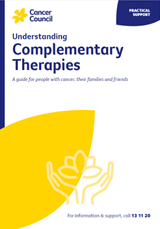
Download a PDF booklet on this topic.
More resources

A/Prof Geraldine McDonald, Director Patient Experience and Wellbeing, Peter MacCallum Cancer Centre, VIC; Laura Carman, 13 11 20 Consultant, Cancer Council Victoria; A/Prof Christine Carrington, Senior Consultant Pharmacist Cancer Services, Princess Alexandra Hospital and Metro South Health and The University of Queensland, QLD; Kellie Giannarelli, Consumer; Dr Suzanne Grant, Senior Research Fellow, Integrative Oncology, NICM Health Research Institute, Chris O’Brien Lifehouse, NSW; Vivienne Hansen, Bush and Western Herbal Medicine Practitioner, WA; Karla Jaji, Administration Officer, Nepean Cancer and Wellness Centre, NSW; Dr Laura Kirsten, Senior Clinical Psychologist, Nepean Cancer Services, Nepean Blue Mountains Local Health District, NSW; A/Prof Judith Lacey, Director of Supportive Care and Integrative Oncology, Chris O’Brien Lifehouse, NSW; Adjunct Professor Danforn Lim, Western Sydney University and University of Technology Sydney, NSW; Dr David Mizrahi, Senior Research Fellow and Accredited Exercise Physiologist, The Daffodil Centre, University of Sydney and Cancer Council NSW; Professor Avni Sali AM, Founder and Director, National Institute of Integrative Medicine, VIC; Gillian Thompson, Consumer; A/Prof Kate Webber, Medical Oncologist, Monash Health, VIC; Tanya Wells, Integrative Oncology Consultant and Naturopath, Melbourne Integrative Oncology Group, VIC; Prof Kate White, Professor Cancer Nursing, Cancer Care Research Unit, The Daffodil Centre, University of Sydney and Cancer Council NSW.
View the Cancer Council NSW editorial policy.