

Knowing her risk helped save Amy’s life
 By
Cancer Council NSW
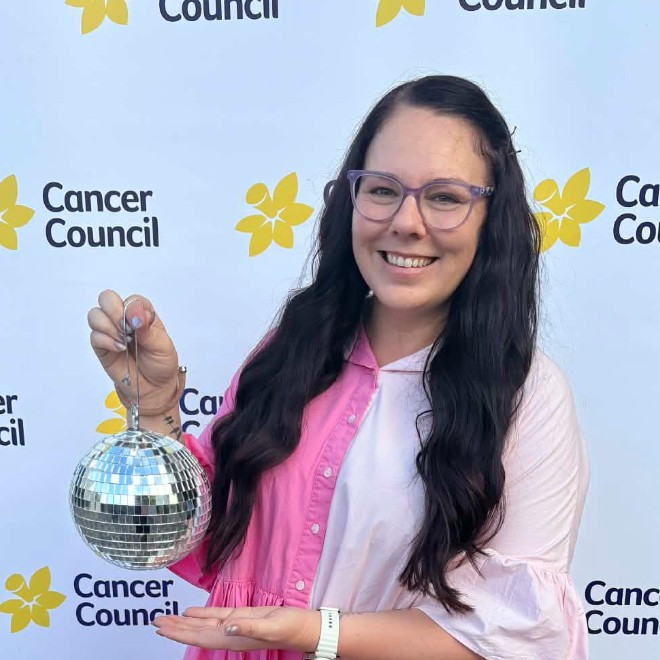
When Amy was just 22, she learnt she had inherited Lynch syndrome, a genetic condition that significantly increases the risk of developing several cancers, including bowel cancer.
It wasn’t entirely unexpected as Amy had already watched cancer devastate her family. Her father died from bowel cancer in 2006 and just two years later, she her mum passed away from thyroid cancer.
But while the diagnosis brought anxiety, it also gave her the knowledge to be proactive about her health.
“I knew my risk, so I could do something about it,” Amy says.
After discovering she carried the Lynch syndrome gene mutation, Amy began routine screenings from the age of 25. Then, at 32, during a routine colonoscopy, doctors discovered a four-centimetre tumour in her bowel.
“It was a shock, even though I’d always known there was a possibility,” Amy says.
Learn more about bowel cancer here
Within two weeks, she underwent major surgery to remove three-quarters of her bowel and more than 40 lymph nodes. Eight weeks later, she began six months of intensive chemotherapy.
“I had a port inserted and received treatment every fortnight,” said Amy.
“I’d spend about four hours in the chemotherapy chair and then go home with a pump for another two days. It was pretty intense. After treatment, I had regular follow-up scans and appointments every three months. These days, I’m up to six-monthly scans, which is nice. It feels like progress.”
A ripple effect
One of the hardest parts of Amy’s diagnosis was the impact on her family. Her children were just seven and eight years old at the time when she was diagnosed. Amy and her husband decided to wait until they understood the treatment plan before telling their children.
“We wanted to be able to explain what was happening and answer their questions.”
Their reactions were very different.
“My son was pretty relaxed about it, but my daughter struggles with anxiety and found it much harder. There really isn’t a rulebook for these conversations.”
Adding to the complexity was the fact that Lynch syndrome is hereditary.
“My daughter’s first thought was whether she could be tested too,” Amy says. “But children can’t be tested until they’re 18 and can make that decision for themselves. It’s a difficult conversation because you want to protect them, but you also want them to understand their family history when the time is right.
The hidden cost of cancer
Amy says the financial impact was one of the biggest challenges.
At the time of her diagnosis, she was between jobs and had limited leave available. With a mortgage, household bills and two children to support, the pressure quickly mounted.
“We went through our savings very quickly,” she says. “There are a lot of gaps in the system when someone becomes too unwell to work. We ended up relying on things like Zip Pay and Afterpay just to get through. We’re still paying some of that off today.”
Amy says support from Cancer Council NSW and her social worker made a significant difference.
“They helped us access assistance and support we didn’t even know existed. When you’re worried about how you’ll pay for groceries, that kind of help means everything.”
Stars of Orange
Today, Amy is doing well. She runs regularly and has returned to martial arts.
She signed up for Stars of Orange to ‘give back’ to Cancer Council and raise awareness of genetic conditions like Lynch syndrome.
“Cancer Council supported me so much throughout my treatment, and this felt like a way to repay that support while also raising awareness about bowel cancer and Lynch syndrome,” she said.
“The experience was fantastic. I used to love dancing when I was younger, so getting back on the dance floor was a lot of fun. It brought something really positive into a difficult chapter of our lives. The support was incredible. My neighbours, friends and the wider Orange community really got behind me. We raised far more than I ever expected. Across the eight Stars participants, we raised more than $300,000, which was amazing. It really showed me how generous people can be when a cause means something to them.”
For Amy, sharing her story is a way to encourage others to understand their family history.
“Learn about your family history. If there’s a genetic risk, don’t be afraid to get tested and stay on top of your screening. For me, knowing I had Lynch syndrome and having regular colonoscopies saved my life,” Amy explained.
“If sharing my story encourages even one person to get checked earlier, then it’s worth it.”
About Lynch Syndrome
Less than 5% of bowel cancers are linked to Lynch syndrome, which causes a fault in the gene that helps repair a cell’s DNA. People with Lynch syndrome have an increased risk of developing bowel cancer, cancer of the uterus, and other cancers such as kidney, bladder and ovarian. Bowel cancer may also happen at a younger age than usual. Find out more about Lynch syndrome at Cancer Council Victoria.
Stats about bowel cancer
- Bowel cancer, also known as colorectal cancer, is Australia’s second biggest cancer killer. Many people don’t realise it kills more Australians each year than breast, prostate or skin cancer.
- Over 90 per cent of bowel cancers can be successfully treated if detected early (Stage 1 or 2). Finding bowel cancer early can substantially improve a person’s chance of surviving the disease.
- Every day, around 15 people will be diagnosed with bowel cancer in NSW.
- Every day, around 5 people die from bowel cancer in NSW.
- People aged between 50 and 74 will receive a free home bowel testing kit through the National Bowel Cancer Screening Program from the Australian Government every two years. People aged 45-49 can opt-in to screening on the Department of Health and Aged Care website. Doing this simple home test could save your life.