- Home
- Eye melanoma
- Treatment
Eye melanoma treatment
In this section, we discuss the different treatment options available for someone diagnosed with eye melanoma.
Learn more about:
Your treatment options
You will be cared for by a multidisciplinary team (MDT) of health professionals. Because melanoma found in the eye is a rare cancer, you may also be referred to a specialist treatment centre or an eye hospital. The MDT may include an ophthalmologist, radiation oncologist (to prescribe and coordinate a course of radiation therapy), medical oncologist (to prescribe and coordinate drug or systemic treatments, such as immunotherapy), nurses, and allied health professionals (e.g. psychologist, counsellor, social worker, physiotherapist or occupational therapist).
Your doctor will talk to you about the best treatment available to you. Options will depend on tumour size and location, and whether it has spread. The aim of treatment is to remove the cancer, and try to save the eye and as much vision as possible. Treatment options may include surgery, radiation therapy, laser treatment, photodynamic therapy and immunotherapy. These may be given alone or in combination. There may be new treatments being investigated through clinical trials (including targeted therapy) and through the Australasian Ocular Melanoma Alliance (AOMA).
Learn more about clinical trials and research.
Certain small eye melanomas may not need immediate treatment. Instead, you may have regular checks until there is growth or an increased risk.
Surgery
Surgery may be done under a local anaesthetic with sedation or under a general anaesthetic. You may need to stay in hospital for a period of time.
Learn more about surgery.
What are the types of surgery for eye melanoma?
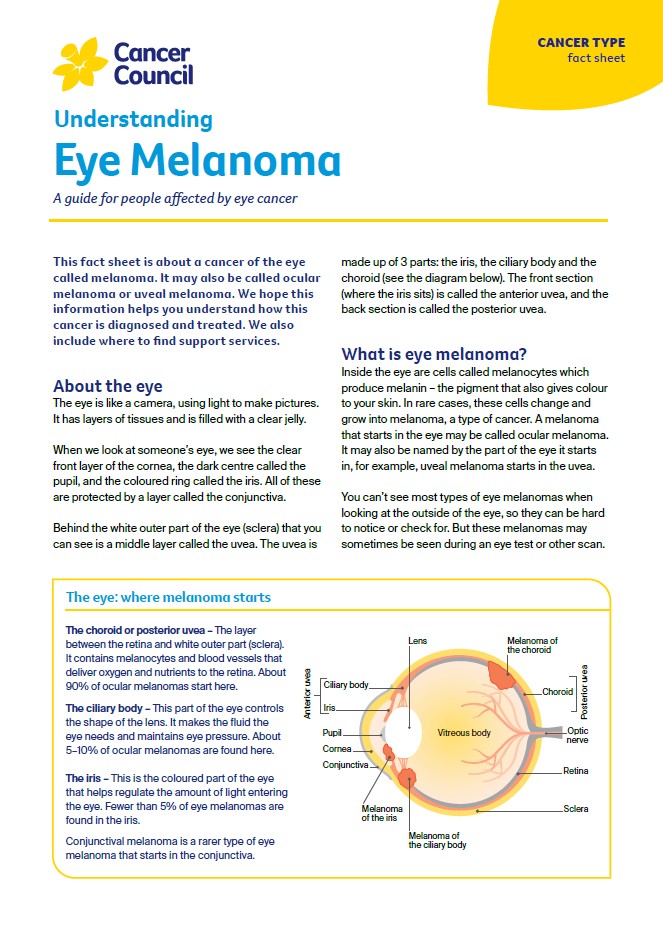
| Iridectomy | Removal of part of the iris (the coloured part of the eye). May be done for a biopsy or to remove small melanomas. |
| Iridocyclectomy | Removal of part of the iris and the ciliary body. Used for certain small to medium melanomas. |
| Enucleation | Removal of the entire eyeball. This is done if the melanoma is large or if vision in the eye has already been lost. After surgery, an artificial eye is usually fitted to match the size and colour of your other eye. |
| Orbital exenteration | Removal of the eyeball and some surrounding tissue. This may include some or all of the eyelid, fat and muscles. Only used for advanced cancers, or cancers that have grown into the area that surrounds the eyeball. |
Radiation therapy
Radiation therapy uses high-energy rays to destroy cancer cells. It may be used:
- after surgery, to destroy any remaining cancer cells and stop the cancer coming back
- if the cancer can’t be removed with surgery
- instead of removing the eye (enucleation)
- if the cancer has spread to other parts of the body.
Radiation therapy doesn’t hurt and is given over a set time period. It’s given in different ways.
Plaque brachytherapy
A small disc (a plaque) containing radioactive material is put over the tumour during surgery. You may have a general anaesthetic (so you are asleep) or a local anaesthetic with sedation (so you are awake but relaxed and feel no pain). You stay in hospital for 2–7 days with the disc in place. Then you have a short operation to remove the disc and go home.
For more information, visit The Royal Victorian Eye and Ear Hospital to read their fact sheet on Plaque Radiotherapy.
Stereotactic radiation therapy
This uses radiation in the form of x-ray beams. A large machine directs multiple small beams of radiation to precisely target the tumour in high doses. You usually need 5 sessions given over 10 days. This is planned during your first appointment. You will meet with a radiation oncologist and lie on an examination table for a CT scan (in the same position as during treatment). A mesh mask keeps your head still, but can make some people feel anxious. The specialist will plan the treatment area, type of radiation and how to deliver the right dose.
Radiation therapists then deliver the treatment sessions over a number of days. A treatment session doesn’t take very long and you can usually go home after each one.
Proton beam radiation therapy
This uses proton beams rather than x-ray beams. Protons release most of their radiation within the cancer, protecting nearby tissue. Treatment is given in high doses over several days. Proton therapy is most useful near very sensitive areas. It’s not currently operating in Australia but may be available in the future. Talk to your radiation oncologist about your options.
Learn more about radiation therapy.
Find information on radiation therapy in Arabic, Greek, Simplified and Traditional Chinese, Hindi, Korean, Italian, Spanish and Vietnamese.
Laser therapy or photodynamic therapy
Laser treatment uses an infrared laser to heat and destroy cancer cells. Laser treatment is sometimes combined with photodynamic therapy, which uses a laser combined with a light-sensitive drug to destroy cancer cells. The drug is injected into your vein and makes the cells in your body more sensitive to light. The treatment is painless, but you will be sensitive to light for several days after treatment.
Immunotherapy
Immunotherapy is a drug treatment that uses your body’s immune system to fight cancer. Immunotherapy for uveal melanoma that has spread is available for eligible patients (visit eviQ for more information). Other immunotherapy drugs may become available, and some are being investigated in clinical trials. Ask your doctor if these treatments are suitable for you.
Learn more about immunotherapy.
Targeted therapy
Targeted therapy is a drug treatment that targets specific features of cancer cells to stop the cancer growing and spreading. Drugs are given as tablets or through a drip into a vein. They travel through the body like chemotherapy, but they work in a more focused way. A clinical trial is testing targeted therapy for eye melanoma. Your doctors may test the cancer cells (from a biopsy) to see if this treatment is likely to work for you.
Learn more about targeted therapy.
Should I join a clinical trial?
Your doctor may suggest you take part in a clinical trial. Clinical trials test new or modified treatments and ways of diagnosing disease to see if they are better than current methods.
For example, if you join a randomised trial for a new treatment, you’ll be chosen at random to receive either the best existing treatment or the modified new treatment. Over the years, trials have improved treatments and led to better outcomes for people diagnosed with cancer.
If you decide to take part in a clinical trial, you can withdraw at any time.
For more information, visit Australian Cancer Trials.
Learn more about clinical trials and research.
Podcast: Making Treatment Decisions
Listen to more episodes from our podcast for people affected by cancer
Video: Radiation therapy
Watch this short video to learn more about radiation therapy.
Click on Settings
to turn on auto-generated subtitles in your language.
Video: Immunotherapy and targeted therapy
Watch this short video to learn more about targeted and immunotherapy.
Click on Settings
to turn on auto-generated subtitles in your language.
More resources
Dr Li-Anne Lim, Ocular Oncologist, Sydney Eye Hospital, NSW; Carolyn Alkemade, Consumer; Elaine Cook, 13 11 20 Consultant, Cancer Council Victoria, VIC; Peta Holly, Melanoma Telehealth Nurse, Melanoma Patients Australia; Dr Jon Lam, Ophthalmologist, Vitreoretinal Surgeon and Vitreoretinal Oncologist – Perth Retina, Fremantle Hospital and Royal Perth Hospital, WA; Dr John McKenzie, Ophthalmic Surgeon, Head of Oncology, The Royal Victorian Eye and Ear Hospital, Deputy Director of Ophthalmology, The Royal Children’s Hospital, Head of Ophthalmology, Western Health, VIC; Margie Reynolds, Consumer; Dr Wenchang Wong, Radiation Oncologist, Prince of Wales Hospital, NSW.
View the Cancer Council NSW editorial policy.