

Eye melanoma is a rare cancer that forms in the eye. It may also be called ocular melanoma or uveal melanoma.
Learn more about:
- How does the eye work?
- What is eye melanoma?
- Where does eye melanoma start?
- Who gets eye melanoma?
- What causes eye melanoma?
How does the eye work?
The eye is like a camera, using light to make pictures. It has layers of tissues and is filled with a clear jelly.
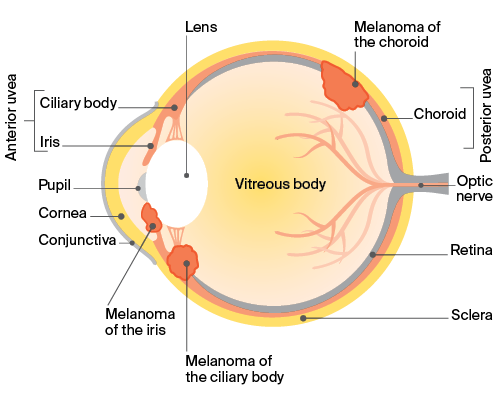
When we look at someone’s eye, we see the clear front layer of the cornea, the dark centre called the pupil, and the coloured ring called the iris. All of these are protected by a layer called the conjunctiva.
Behind the white outer part of the eye (sclera) that you can see is a middle layer called the uvea. The uvea is made up of 3 parts: the iris, the ciliary body and the choroid. The front section (where the iris sits) is called the anterior uvea, and the back section is called the posterior uvea.
What is eye melanoma?
Inside the eye are cells called melanocytes which produce melanin – the pigment that also gives colour to your skin. In rare cases, these cells change and grow into melanoma, a type of cancer. A melanoma that starts in the eye may be called ocular melanoma. It may also be named by the part of the eye it starts in, for example, uveal melanoma starts in the uvea.
You can’t see most types of eye melanomas when looking at the outside of the eye, so they can be hard to notice or check for. But these melanomas may sometimes be seen during an eye test or other scan.
Where does eye melanoma start?
The choroid or posterior uvea – The layer between the retina and white outer part (sclera). It contains melanocytes and blood vessels that deliver oxygen and nutrients to the retina. About 90% of ocular melanomas start here.
The ciliary body – This part of the eye controls the shape of the lens. It makes the fluid the eye needs and maintains eye pressure. About 5–10% of ocular melanomas are found here.
The iris – This is the coloured part of the eye that helps regulate the amount of light entering the eye. Fewer than 5% of eye melanomas are found in the iris.
Conjunctival melanoma is a rarer type of eye melanoma that starts in the conjunctiva.
Who gets eye melanoma?
Cancer in the eye is a rare type of cancer. Uveal melanoma is the most common type of cancer that starts inside the eye, but it is still rare. About 200 Australians are diagnosed with it each year, and it is more common in older people and in men. Conjunctival melanoma is very rare.
Rare cancers can have their own challenges. You may need to travel for treatment or your doctor may not have treated this cancer. For information about being diagnosed and coping with a rare type of cancer, see Rare and less common cancers.
What causes eye melanoma?
It’s unclear whether UV exposure (a risk factor for skin melanoma) is a risk factor for eye melanoma. Some studies have linked conjunctival melanoma to UV exposure (e.g. using tanning beds). Eye melanoma is less common in people with naturally brown eyes, and people with dark skin. While doctors don’t know the exact cause, factors that may increase your ocular melanoma risk include:
- fair skin that burns easily
- blue or light eye colour
- fair or red hair
- older age (risk increases with age)
- a family history of melanoma
- certain skin conditions (e.g. dysplastic naevus syndrome)
- eye “freckles” or growths
- primary acquired melanosis (PAM), which causes brown or dark pigmentation on the conjunctiva, usually in one eye. People with PAM need regular check-ups so that any changes can be found early.
→ READ MORE: Eye melanoma symptoms
Key resource
The information on this page is also available for download.
Dr Li-Anne Lim, Ocular Oncologist, Sydney Eye Hospital, NSW; Carolyn Alkemade, Consumer; Elaine Cook, 13 11 20 Consultant, Cancer Council Victoria, VIC; Peta Holly, Melanoma Telehealth Nurse, Melanoma Patients Australia; Dr Jon Lam, Ophthalmologist, Vitreoretinal Surgeon and Vitreoretinal Oncologist – Perth Retina, Fremantle Hospital and Royal Perth Hospital, WA; Dr John McKenzie, Ophthalmic Surgeon, Head of Oncology, The Royal Victorian Eye and Ear Hospital, Deputy Director of Ophthalmology, The Royal Children’s Hospital, Head of Ophthalmology, Western Health, VIC; Margie Reynolds, Consumer; Dr Wenchang Wong, Radiation Oncologist, Prince of Wales Hospital, NSW.
View the Cancer Council NSW editorial policy.