

In this section we discuss what stomach cancer is, who gets it and what causes it.
Learn more about:
- What is stomach cancer?
- The stomach
- Other types of stomach cancer
- Who gets stomach cancer?
- What causes stomach cancer?
What is stomach cancer?
Stomach cancer develops when cells in any part of the stomach grow and divide in an abnormal way. Tumours can begin anywhere in the stomach, although most start in the stomach’s inner lining (mucosa). This type of cancer is called adenocarcinoma of the stomach or gastric cancer.
Stomach cancer can spread to nearby lymph nodes or to other parts of the body, such as the liver and lungs. It may also spread to the lining of the abdomen (peritoneum).
The stomach
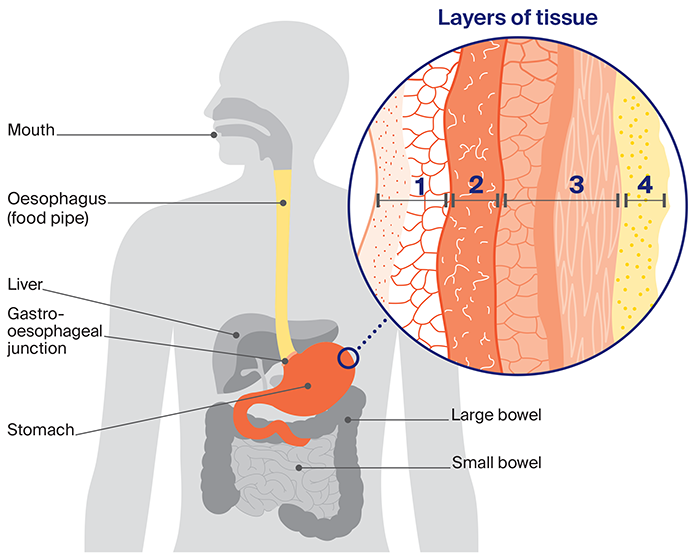
The stomach is a hollow, muscular organ, which is shaped like a pouch. It is part of the digestive system, which helps your body break down food and turn it into energy.
The top of the stomach connects to the end of the oesophagus (food pipe). The bottom of the stomach connects to the start of the small bowel.
What the stomach does
When you eat, food goes into your stomach. The stomach uses its own digestive juices and muscle
movements to break the food down into a thick liquid. This liquid moves into the small bowel, where
nutrients are absorbed into your blood.
The parts of the food your body does not need go into the large bowel and leave the body as waste known as faeces (also called stools or poo).
Layers of tissue in the stomach wall |
|
| 1. mucosa |
|
| 2. submucosa |
|
| 3. muscularis externa (muscle layer) |
|
| 4. serosa (outer layer) |
|
Anatomy of the stomach
Other types of stomach cancer
Other types of cancer can start in the stomach. These include small cell carcinomas, lymphomas, neuroendocrine tumours and gastrointestinal stromal tumours. These types of cancer aren’t discussed in this fact sheet and their treatment may be different. Call Cancer Council 13 11 20 for more information.
Who gets stomach cancer?
About 2740 people are diagnosed with stomach cancer in Australia each year. Men are almost twice as likely as women to be diagnosed with stomach cancer. It is more common in people over 60, but it can occur at any age.
What causes stomach cancer?
The exact causes of stomach cancer are not known. Below are some risk factors, but most people with these risk factors do not develop stomach cancer:
- being over 60
- infection with the bacteria Helicobacter pylori (H. pylori)
- smoking tobacco
- low red blood cell levels related to pernicious anaemia
- a family history of stomach cancer
- having an inherited genetic condition like familial adenomatous polyposis (FAP), Lynch syndrome, hereditary diffuse gastric cancer (HDGC), or gastric adenocarcinoma and proximal polyposis of the stomach (GAPPS)
- inflammation of the stomach (chronic gastritis)
- being overweight or obese
- drinking alcohol
- eating a diet high in salt-preserved foods (e.g. processed meats, pickled vegetables)
- having part of the stomach removed for a non-cancerous condition
→ READ MORE: Stomach cancer symptoms
More resources

Prof David I Watson, Matthew Flinders Distinguished Professor of Surgery, Flinders University, and Senior Consultant Surgeon, Oesophago-Gastric Surgery Unit, Flinders Medical Centre, SA; Prof Bryan Burmeister, Senior Radiation Oncologist, GenesisCare Fraser Coast and Hervey Bay Hospital, QLD; Dr Natalie Collier, Radiation Oncologist, Wollongong Hospital, NSW; A/Prof Melissa Eastgate, A/Executive Director, Cancer Care Services, Royal Brisbane and Women’s Hospital, QLD; Brett Hall, Consumer; Natalie Lalor, 13 11 20 Consultant, Cancer Council Victoria; Chris Menzies, Upper GI Cancer Nurse Consultant, Flinders Medical Centre and Southern Adelaide Local Health Network, SA; Stefanie Simnadis, Clinical Dietitian, St John of God Subiaco Hospital, WA; Prof Rajvinder Singh, Professor of Medicine, University of Adelaide, and Director, Gastroenterology Department and Head of Endoscopy, Lyell McEwin Hospital, SA.
View the Cancer Council NSW editorial policy.