

In this section we look at gallbladder cancer, how it is diagnosed and treated, as well as where to go for additional information and support services.
Learn more about:
- Overview
- About the gallbladder and bile ducts
- What are gallbladder and bile duct cancers?
- Who gets it?
- What causes it?
Overview
Many people feel shocked and upset when told they have cancer. You may experience strong emotions after a cancer diagnosis, especially if your cancer is rare or less common like gallbladder and bile duct cancer.
A feeling of being alone is usual with rare cancers, and you might be worried about how much is known about your type of cancer and how to manage it.
You may also be concerned about the cancer coming back after treatment. Contacting local support services can help overcome feelings of isolation and will give you information that you may find useful.
Rare Cancers Australia have a directory of health professionals and cancer services across Australia.
About the gallbladder and bile ducts
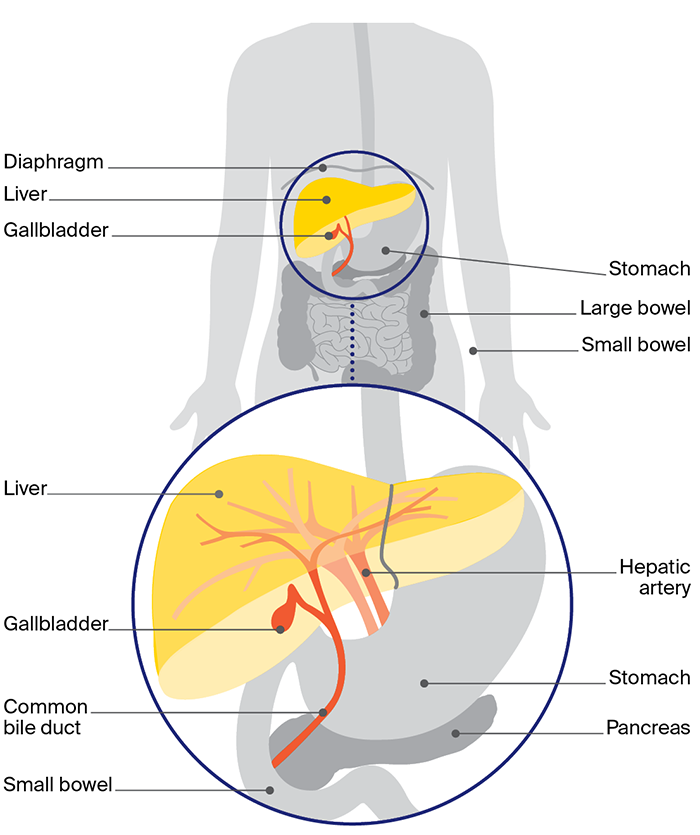
The gallbladder is a small, pear-shaped organ on the right side of the abdomen (belly), under the liver. It is part of the digestive system.
The gallbladder stores bile, a fluid that is made by the liver and helps your body break down fats in the foods you eat.
Bile ducts are small tubes that carry bile from the liver into the small bowel (small intestine).
What are gallbladder and bile duct cancers?
Cancer is when cells in any part of the body become abnormal and keep growing to form a mass or lump called a tumour.
Gallbladder and bile duct cancers are 2 different types of cancers but affect the same area of the body. Bile duct cancer is sometimes called cholangiocarcinoma or biliary tract cancer.
About 85% of gallbladder cancers are adenocarcinomas, which are tumours that start in the cells that line the inside of the gallbladder.
The other, less common, types of gallbladder cancer include:
- squamous cell carcinoma
- sarcoma
- lymphoma.
Bile duct cancer can happen in different places within the bile duct system. Cancers in the bile ducts that are within the liver are called intrahepatic, cancers at the point where the left and right hepatic ducts meet are called Klatskin tumours and cancers in the common bile duct outside the liver are extrahepatic tumours.
Malignant (cancerous) tumours have the potential to spread to other parts of the body through the bloodstream or lymph vessels and form another tumour at a new site. This new tumour is known as secondary cancer or metastasis.
Who gets it?
About 1430 Australians are diagnosed each year with gallbladder and bile duct cancers. People 65 or over are more likely to be diagnosed with these cancers than younger people.
What causes it?
The exact cause of most gallbladder cancers is not known, but factors that increase your risk include:
- having had gallstones or inflammation of the gallbladder in the past
- family history of gallbladder cancer (close relative such as mother, father, sibling or child)
- other gallbladder and bile duct conditions and abnormalities, such as gallbladder polyps, choledochal cysts (bile-filled cysts) and calcified gallbladder (also known as porcelain gallbladder).
The main risk factor for bile duct cancer is long-term inflammation of the bile ducts. This may be caused by liver problems such as hepatitis and fatty liver disease.
Other risk factors include:
- exposure to certain chemicals in the printing industry
- having inflammatory bowel disease or liver conditions (which can cause scar tissue in the bile ducts).
However, most people with these risk factors do not develop cancer.
→ READ MORE: Gallbladder and bile duct symptoms
Key resource
The information on this page is also available for download.
Dr Corina Behrenbruch, Colorectal Surgeon, St Vincent’s Hospital Fitzroy, Peter MacCallum Cancer Centre, and The University of Melbourne, VIC; Dr Prasad Cooray, Medical Oncologist and Clinical Lecturer – The University of Melbourne Department of Surgery, Austin Health, VIC; Prof Jacob George, The University of Sydney and Head, Gastroenterology and Hepatology, Westmead Hospital and Western Sydney Local Health District, NSW; Dr Andrew Oar, Radiation Oncologist, Icon Cancer Centre, Gold Coast University Hospital, QLD; Chris Rivett, 13 11 20 Consultant, Cancer Council SA; Nicole Williams, HepatoPancreatoBiliary (HPB) Nurse Consultant, Southern Adelaide Local Health Network, SA.
View the Cancer Council NSW editorial policy.