
Chinese medicine is based on the idea of maintaining balance between the mind, body and environment to prevent and manage diseases. It focuses on the person’s overall condition, not just their symptoms.
There are different Chinese medicine practices, including:
- acupuncture
- breathing and movement exercises called qi gong
- movement exercises called tai chi
- the practice of burning herbs near the skin called moxibustion
- herbal medicine
- Chinese dietary therapy or food therapy (what you eat).
Key concepts
| Qi | According to Chinese medicine, everyone has a vital energy or force in the body known as qi (pronounced “chee”). When you are healthy, qi flows easily through the body’s meridians (channels). If the flow of qi becomes blocked, the body’s harmony and balance is affected, causing disease. |
| Yin and Yang | Qi is made up of 2 opposite but complementary forces known as Yin, represented by water, and Yang, by fire. Yin and Yang are believed to be in everything and the balance between them maintains harmony in your body, mind and the universe. |
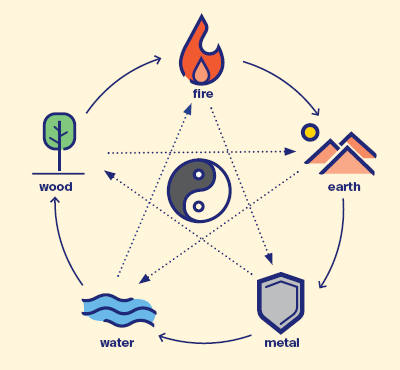
| Elements | Chinese medicine uses the theory of 5 elements – fire, earth, metal, water and wood. These elements relate to particular organs and tissues in the body. |
What to expect
A practitioner will ask you questions and do a physical examination, which may include looking at your tongue and taking your pulse. Treatment is individual and may include a combination of therapies.
To learn more about what Chinese medicine is and what to expect during a Chinese medicine consultation, visit the Chinese Medicine Board of Australia’s (CMBA).
The 5 elements in Chinese medicine
Chinese herbal medicine
In Chinese herbal medicine, various parts of certain plants (such as leaves, roots, stems, flowers and seeds) are used as medicine, based on the belief that they can influence meridians and help restore balance in the body.
What to expect
A practitioner will choose a combination of herbs and foods with the aim of bringing your body back into balance. They may make a formula tailored to you, or dispense herbal medicines pre-packaged as granules, pills or raw herbs to be made into a tea.
Evidence
Many Chinese herbs have been scientifically evaluated for how well they work for people with cancer. Studies have found benefits for some herbs. For example,
American ginseng has shown benefits for cancer-related fatigue. Research is continuing to examine the benefits of different herbs and different herbal combinations.
Safety
Chinese herbal medicine is a complex area and you should see a registered Chinese medicine practitioner rather than treating yourself. Learn tips on using herbs and visit The Australian Health Practitioner Regulation Agency (Ahpra) to check your practitioner is registered with the Chinese Medicine Board of Australia.
Meditation and Relaxation Podcast
Listen to more of our meditation and relaxation podcast for people affected by cancer
Key resource
Download a PDF booklet on this topic.
More resources
A/Prof Geraldine McDonald, Director Patient Experience and Wellbeing, Peter MacCallum Cancer Centre, VIC; Laura Carman, 13 11 20 Consultant, Cancer Council Victoria; A/Prof Christine Carrington, Senior Consultant Pharmacist Cancer Services, Princess Alexandra Hospital and Metro South Health and The University of Queensland, QLD; Kellie Giannarelli, Consumer; Dr Suzanne Grant, Senior Research Fellow, Integrative Oncology, NICM Health Research Institute, Chris O’Brien Lifehouse, NSW; Vivienne Hansen, Bush and Western Herbal Medicine Practitioner, WA; Karla Jaji, Administration Officer, Nepean Cancer and Wellness Centre, NSW; Dr Laura Kirsten, Senior Clinical Psychologist, Nepean Cancer Services, Nepean Blue Mountains Local Health District, NSW; A/Prof Judith Lacey, Director of Supportive Care and Integrative Oncology, Chris O’Brien Lifehouse, NSW; Adjunct Professor Danforn Lim, Western Sydney University and University of Technology Sydney, NSW; Dr David Mizrahi, Senior Research Fellow and Accredited Exercise Physiologist, The Daffodil Centre, University of Sydney and Cancer Council NSW; Professor Avni Sali AM, Founder and Director, National Institute of Integrative Medicine, VIC; Gillian Thompson, Consumer; A/Prof Kate Webber, Medical Oncologist, Monash Health, VIC; Tanya Wells, Integrative Oncology Consultant and Naturopath, Melbourne Integrative Oncology Group, VIC; Prof Kate White, Professor Cancer Nursing, Cancer Care Research Unit, The Daffodil Centre, University of Sydney and Cancer Council NSW.
View the Cancer Council NSW editorial policy.