

Learn about lymphoma, a cancer of the lymphatic system caused by abnormal white blood cells forming tumors.
Learn more about:
For your community
Overview
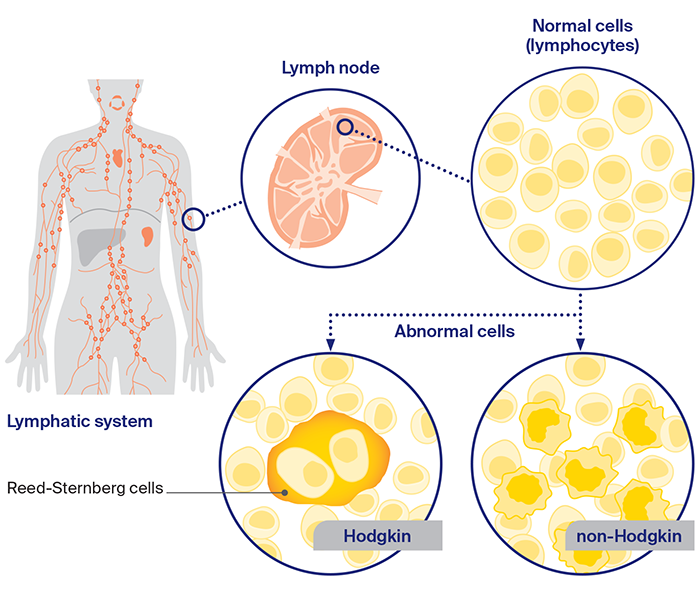
Lymphoma is cancer of the body’s lymphatic system. It happens when white blood cells called lymphocytes become abnormal and grow uncontrollably to form a lump (tumour), usually in a lymph node.
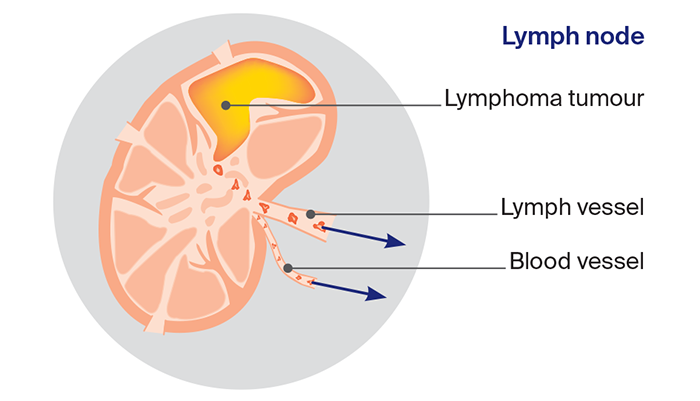
If these abnormal lymphocytes continue to build up, they can spread and form a tumour in another part of the lymphatic system or, sometimes, in an organ outside the lymphatic system, such as the liver or lung. This is still lymphoma, not another type of cancer.
Sometimes other types of cancer spread to the lymph nodes. This is not lymphoma. For example, breast cancer that has spread to the lymph nodes is still called breast cancer.
What is blood cancer?
Cancer is a disease of the cells. Cells are the body’s basic building blocks – they make up tissues and organs. The body constantly makes new cells to help us grow, replace worn-out tissue and to heal injuries.
Normally, cells multiply and die in an orderly way, so that each new cell replaces one that is lost. Cancer develops when cells become abnormal and keep growing. These abnormal cells may turn into cancer.
When a cancer begins in abnormal blood cells, it is known as a blood cancer. The 3 main groups of blood cancers are:
How lymphoma starts
Lymphoma usually starts in the lymph nodes.
How lymphoma spreads
Lymphoma can travel through the lymphatic system (or sometimes through the blood) to other parts of the body.
The lymphatic system
Lymphoma is a cancer of the lymphatic system. The lymphatic system is part of the immune system, which protects the body against disease and infection. The lymphatic system is made up of a network of vessels, tissues and organs.
| Lymph nodes |
Also called lymph glands, these small, bean-shaped structures are made up of lymph tissue. There are about 600 lymph nodes found in groups along the lymph vessels, including in the neck, underarms, chest, abdomen (belly) and groin. Lymph nodes filter lymph fluid before emptying most of the fluid into the bloodstream. |
| Lymph vessels | These thin tubes are found throughout the body and in organs such as the spleen, liver, thymus and bone marrow. Lymph vessels carry lymph fluid around the body. |
| Lymph fluid | This clear fluid travels to and from the tissues in the body, carrying nutrients throughout the body and taking away bacteria, viruses, abnormal cells and cell debris. |
| Other lymph tissue |
As well as lymph nodes, lymph tissue is found in other parts of the body:
|
Parts of the lymphatic system

The role of blood cells
Bone marrow is the soft, spongy material inside bones. It makes stem cells, which are unspecialised cells that usually grow into one of three main types of blood cells: red blood cells, white blood cells and platelets. Each type of blood cell has a specific job to do.
White blood cells are part of the immune system and help fight infections. There are different types of white blood cells and they have different roles. The lymph nodes, lymph tissue and lymph fluid all contain the white blood cells known as lymphocytes.
Types of lymphocytes include:
- B-cells – make antibodies to fight infection
- T-cells – attack invaders (antigens) by killing them directly or by helping B-cells make antibodies
- NK-cells (natural killer cells) – rarer lymphocytes that specialise in killing diseased cells, including cancer cells.
Diseases such as lymphoma and treatments such as chemotherapy can lower the number of blood cells in the body and cause:
- a low level of white blood cells (leukopenia), which increases your risk of infection
- a low level of red blood cells (anaemia), which may make you look pale and feel tired, breathless and dizzy
- a low level of platelets (thrombocytopenia), which means you bruise or bleed easily.
For more information about lymphoma and other blood cancers, visit Lymphoma Australia, or the Leukaemia Foundation.
Types of blood cells
The blood contains different types of cells, which all play different roles in the body.

What are the main types of lymphoma?
There are 2 main groups of lymphoma:
- Hodgkin lymphoma
- Non-Hodgkin lymphoma.
Both are blood cancers that start in the lymphatic system and affect white blood cells called lymphocytes. Lymphocytes are special white blood cells that help your body fight off germs and stay healthy.
Both groups of lymphoma usually start in a lymph node in one or more places in the body. They can then spread through the lymphatic system from one group of lymph nodes to another. They can also spread to other lymph tissue, particularly in the bone marrow and spleen.
Sometimes, lymphoma can start in or spread to tissue in an organ outside the lymphatic system, such as the stomach, bowel, skin, bone, or brain and spinal cord (central nervous system). This is known as extranodal disease, and is more common with non-Hodgkin lymphoma.
How are Hodgkin lymphoma and non-Hodgkin lymphoma different?
A key difference between Hodgkin and non-Hodgkin lymphomas is in the cells: Hodgkin lymphoma involves a special cell called the Reed-Sternberg cell, while non-Hodgkin lymphoma does not.
Hodgkin lymphoma is more common in teens and young adults, while non-Hodgkin lymphoma is more common in older people.
Who gets lymphoma?
Non-Hodgkin lymphoma is more common in Australia.
Hodgkin lymphoma
About 839 people are diagnosed with Hodgkin lymphoma in Australia each year. Hodgkin lymphoma can occur at any age, but it most commonly develops in younger people (with almost half of cases occurring in those aged 15–39), and in people aged 60 years and over. It is slightly more common in men than women.
Non-Hodgkin lymphoma
Almost 7000 people are diagnosed with non-Hodgkin lymphoma in Australia each year. It is more common in men than women, and most cases occur in people who are aged 60 and over.
Types of Hodgkin and non-Hodgkin lymphoma
Hodgkin lymphoma has 2 main types, while there are more than 60 types of non-Hodgkin lymphoma. Knowing the type helps doctors plan treatment.
Classical Hodgkin lymphoma occurs in about 95% of people with Hodgkin lymphoma. It features large abnormal cells called Reed-Sternberg cells, which have a distinctive appearance when seen under a microscope.
The other main type of Hodgkin lymphoma is called nodular lymphocyte-predominant Hodgkin lymphoma (NLPHL) and is rare. It tends to grow more slowly than classical Hodgkin lymphoma. It features abnormal cells that are sometimes called “popcorn cells” because of how they look.
For non-Hodgkin lymphoma, the type is based on whether the lymphocyte affected is a B-cell, T-cell or, rarely, NK-cell. It is also classified by how fast the lymphoma is growing. The most common types are listed in the tables below.
Common types of non-Hodgkin lymphoma (B-cell)
About 85% of all non-Hodgkin lymphomas are B-cell lymphomas. The most common types of B-cell lymphomas are diffuse large B-cell (about 1 in 3 cases) and follicular lymphoma (about 1 in 5 cases).
| Subtype | Growth (grade) | How it starts |
| diffuse large B-cell | fast-growing; intermediate-grade | the structure of the lymph node is disrupted and the lymphoma cells spread throughout the lymph node |
| follicular | usually slow-growing; low-grade | cells grow slowly in circular groups called follicles |
| small lymphocytic lymphoma (SLL)/ chronic lymphocytic leukaemia (CLL) | slow-growing; low-grade | SLL starts in the lymph nodes and CLL often starts in the bone marrow |
| marginal zone | slow-growing; low-grade | starts in the moist tissue (mucosa) lining some body organs and cavities |
| mantle cell | can look low-grade, but act high-grade | develops in the outer edge (mantle zone) of lymph nodes |
| Burkitt | fast-growing; high-grade | lymph nodes enlarge in many parts of the body |
Common types of non-Hodgkin lymphoma (T-cell)
About 15% of all non-Hodgkin lymphomas are T-cell lymphomas. Some of the most common subtypes are listed below. It can be challenging to diagnose the specific subtype of T-cell lymphoma, and it may take some time.
| Subtype | Growth (grade) | How it starts |
| peripheral T-cell, not otherwise specified | fast-growing; intermediate-grade or high-grade | often occurs as widespread enlarged, painless lymph nodes |
| anaplastic large cell | fast-growing; high-grade | can occur throughout the body or on the skin |
| angioimmunoblastic (also called follicular helper T-cell lymphoma, angioimmunoblastic type) | fast-growing; high-grade | occurs in lymph nodes, can cause skin rashes and produce abnormal proteins |
| cutaneous (skin) T-cell | slow-growing; low-grade | primarily affects the skin; starts as red, scaly patches or raised bumps that can be itchy |
What causes Hodgkin lymphoma?
The causes of both Hodgkin and non-Hodgkin lymphomas are largely unknown. However, research shows that certain factors can increase the risk of developing lymphoma.
Most people with known risk factors do not develop lymphoma, and some people who do get it have no known risk factors. Lymphoma is not contagious. Some risk factors include:
Weakened immune system – The risk of developing lymphoma is higher if your immune system isn’t working properly. This can happen if you have an autoimmune disease, such as rheumatoid arthritis or coeliac disease, or if you take medicines that suppress the immune system after an organ transplant.
Certain infections – Infections with some viruses and bacteria can slightly increase the risk of developing some types of lymphoma. These infections include:
- Helicobacter pylori
- HTLV-1 (human T-cell lymphotropic virus 1)
- hepatitis C
- Epstein-Barr virus
- HHV-8 (human herpesvirus 8).
Family history – The risk is slightly higher if you have a close relative (e.g. parent or sibling) who has had lymphoma.
Breast implant associated cancer
Breast implant associated lymphoma (BIA-ALCL) is a rare type of non-Hodgkin lymphoma linked to some textured breast implants. It usually grows in the scar tissue or fluid around the implant, not in the breast itself. BIA-ALCL is not breast cancer. Most people are treated successfully if it’s found early.
For more information about BIA–ALCL, visit tga.gov.au and search “BIA–ALCL for consumers”. You can also talk to your doctor.
For an overview of what to expect at every stage of your cancer care, visit Guide to Best Cancer Care – Lymphoma. This is a short guide to what is recommended, from diagnosis to treatment and beyond.
→ READ MORE: Lymphoma symptoms
More resources

Dr Ian Bilmon, Haematologist, Westmead Hospital and Sydney Adventist Hospital, NSW; Suzanne Basha, Consumer; Jo Cryer, Clinical Nurse Consultant Haematology, St George Hospital, NSW; Jessica Elliott, Senior Social Worker, Youth Cancer Services, Crown Princess Mary Centre Westmead, NSW; Dr Robin Gasiorowski, Haematologist, Concord and Macquarie University Hospitals, NSW; Prof Angela Hong, Radiation Oncologist, Chris O’Brien Lifehouse, Melanoma Institute Australia, GenesisCare, and Clinical Professor, The University of Sydney, NSW; Karen Maddock, CAR T Cell and Cell Therapy Nurse Practitioner, Westmead Hospital, NSW; Jenn Partenfelder, 13 11 20 Consultant, Cancer Council NSW; Elise Toyer, Clinical Nurse Consultant Haematology, Blacktown Hospital, NSW.
View the Cancer Council NSW editorial policy.